
Journal of Contextual Behavioral Science (JCBS)
Volume 41, July 2026
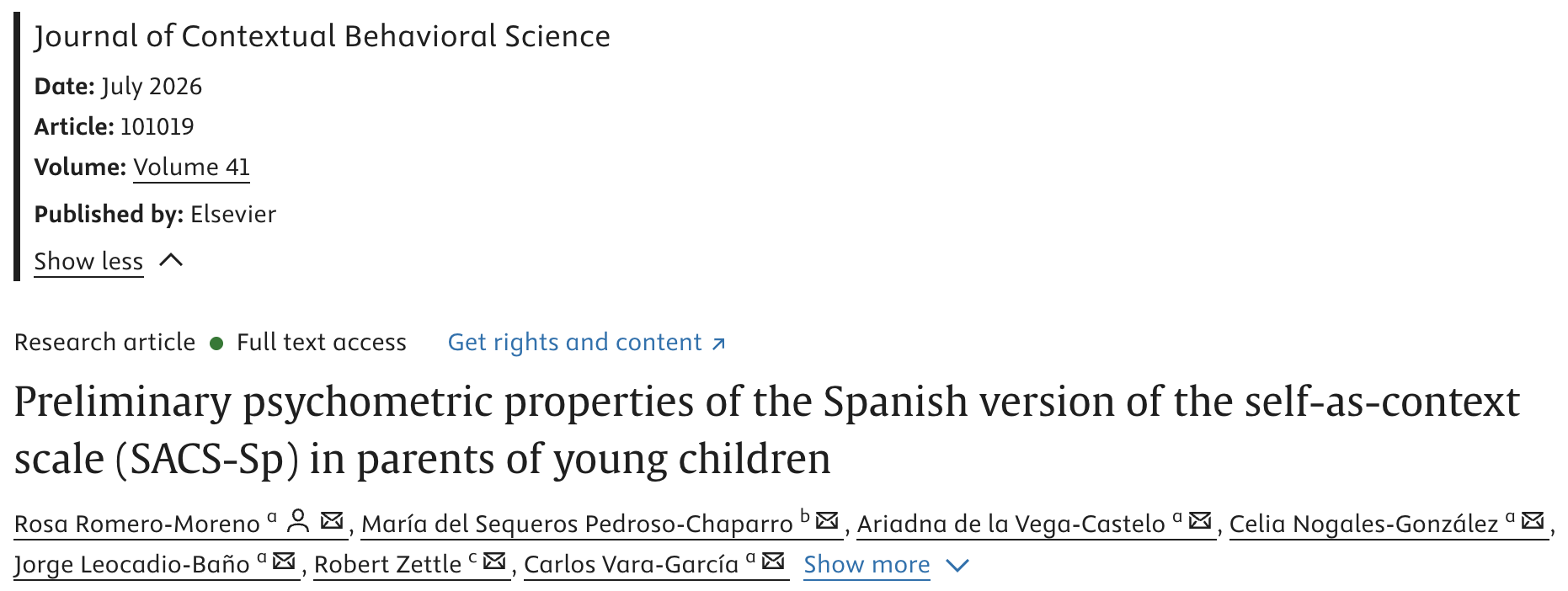
Authors
Rosa Romero-Moreno, María del Sequeros Pedroso-Chaparro, Ariadna de la Vega-Castelo, Celia Nogales-González, Jorge Leocadio-Baño, Robert Zettle, & Carlos Vara-García
Key Findings
- First adaptation and validation of the Self-as-Context Scale into Spanish.
- Examines self-as-context in parents, a high-stress population rarely studied.
- Explores associations with values consistency and self-compassion for the first time.
- Shows centering and transcending predict emotional outcomes beyond stress.
- Supports self-as-context as a transdiagnostic process in parental wellbeing.
Abstract
Introduction
Self-as-context—the invariant perspective-taking that characterizes the observing self—is potentially the most understudied dimension of the model of psychological flexibility on which acceptance and commitment therapy is based. The aim of this study is to develop and evaluate the psychometric properties of the Spanish version of the Self-as-Context Scale (SACS-Sp) in parents of children aged 0 - 6 years old.
Method
A total of 202 parents of young children completed a questionnaire assessing age, sex, parental stressors, psychological flexibility, personal values, self-compassion, and emotional outcomes (depressive symptoms, anxiety symptoms, and positive and negative affect). An exploratory factor analysis was conducted, along with correlation analyses and regression models.
Results
Two SACS dimensions were obtained, Centering (α = .81) and Transcending (α = .91), explaining 67.64% of the variance. The two subscales exhibited distinct predictive patterns across psychological outcomes. Centering was significantly associated with lower levels of depression, anxiety, and negative affect, as well as higher positive affect. Transcending predicted lower depressive symptoms and greater positive affect. These associations remained significant after controlling for sex, age, and stress, highlighting the unique contribution of SAC dimensions to parental emotional adjustment.
Discussion
This study supports the psychometric properties of the Spanish SACS, extends self-as-context research to parents of young children, and shows that self-as-context explains unique variance in parental wellbeing beyond effects of parenting stress. Findings indicate that Centering and Transcending show distinct predictive patterns for parental emotional outcomes. Finally, the study provides novel evidence linking self-as-context with values consistency and self-compassion.