
Journal of Contextual Behavioral Science (JCBS)
Volume 42, October 2026
Authors
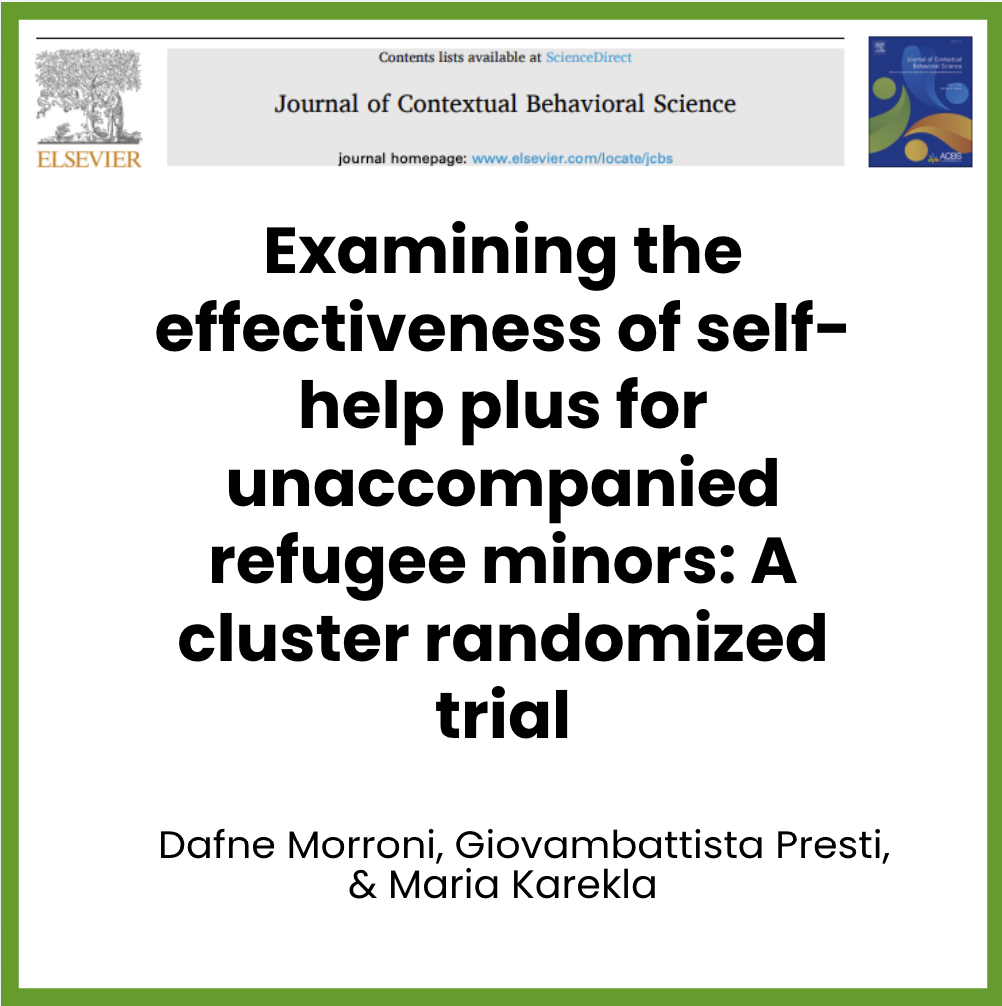
Dafne Morroni, Giovambattista Presti, & Maria Karekla
Key Findings
- Adapted SH+ was examined for the first time with unaccompanied refugee minors.
- No significant intervention effects were found for quality of life or mental health.
- Future research to address engagement, cultural adaptation, and context challenges.
Abstract
Background
Self-Help Plus (SH+) is an intervention found to reduce psychological distress in adult refugees. To date, SH + has not been examined with refugee youth. The purpose of this study was to explore whether an adapted SH + intervention can improve quality of life (QoL), psychological flexibility (PF) and psychological symptoms of depression, anxiety, and stress in unaccompanied refugee minors (UM).
Methods
A cluster randomized controlled trial was carried out in six shelters across Cyprus. Participants were 101 UM between 13 and 18 years old. Randomization occurred by shelters hosting UM, where they either received the four-session SH + intervention (n = 54, Mage = 15.36 years, 22 males, 32 females) or were in the wait-list control group (n = 47, Mage = 16.66 years, 27 males, 20 females). Mixed design analysis of variance and reliable change index analyses were performed on the outcome measures.
Results
In contrast to hypotheses, the intervention group did not differ significantly from the wait-list control group on primary outcomes (i.e., QoL, PF) or secondary outcomes (i.e., mental health symptoms).
Conclusions
Although improvements in psychological symptoms were observed over time in both groups, these changes cannot be attributed specifically to the intervention. These findings highlight the need for further research to examine the applicability of SH + for refugee youth. This can be done by using: (a) culturally and developmentally appropriate measures, (b) enhanced strategies to support engagement, and (c) study designs that consider the complex contextual stressors affecting UM and the practical challenges of research in shelter environments.