
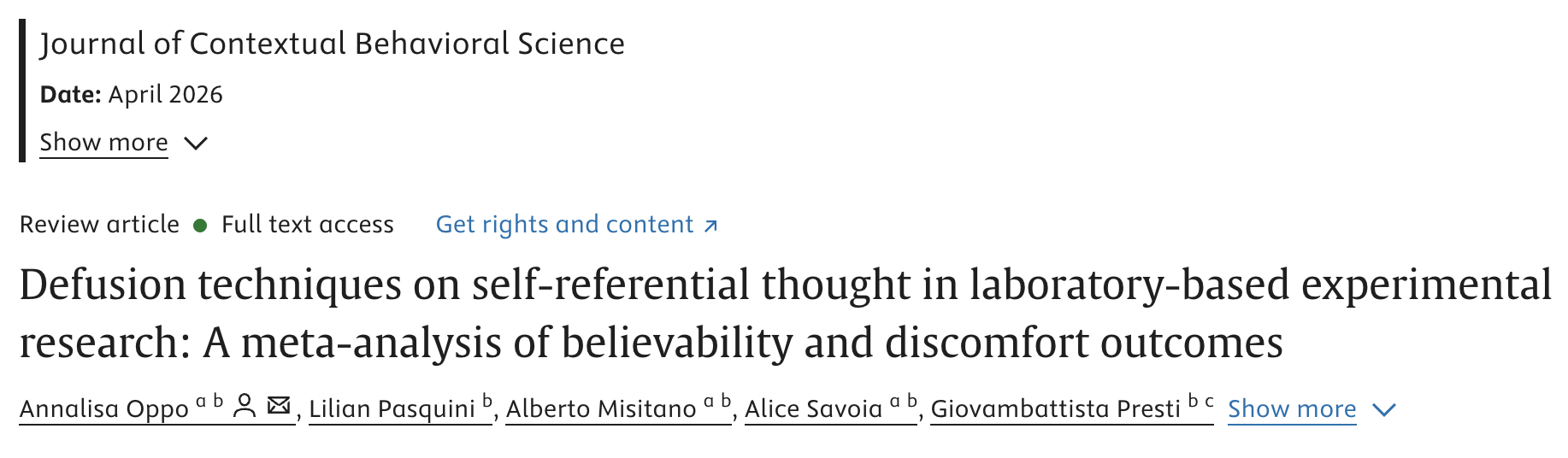
Journal of Contextual Behavioral Science (JCBS)
Volume 40, April 2026
Authors
Annalisa Oppo, Lilian Pasquini, Alberto Misitano, Alice Savoia, & Giovambattista Presti
Key Findings
- Defusion reduces believability and discomfort altering distinct stimulus functions. • Lab studies show how defusion weakens verbal coherence and cognitive fusion.
- Word repetition yields stronger effects on believability than other techniques.
- Findings highlight technique-specific pathways in the behavioral effect of defusion.
- Using one term for varied processes makes defusion conceptually ambiguous.
Abstract
Background
Negative self-referential thoughts often acquire aversive and rigid functions through relational framing, contributing to psychological inflexibility. Cognitive defusion techniques aim to alter these verbally derived functions by reducing the extent to which thoughts govern behavior or evoke distress. Despite their centrality in ACT, no meta-analysis has focused specifically on defusion procedures applied to self-referential stimuli or on functionally distinct outcomes such as believability and discomfort.
Methods
Experimental studies conducted with adult non-clinical samples employing an isolated defusion technique and assessing believability and/or discomfort pre–post intervention were eligible for inclusion. Searches were conducted in PubMed and EBSCOhost through October 30, 2025. Risk of bias was evaluated using the RoB 2 tool. Random-effects models were applied, and subgroup analyses examined differences across defusion procedures.
Results
Twelve studies (22 samples; n = 659) met inclusion criteria. Defusion produced large reductions in believability (Hedges’ g = 1.04, SE = 0.12) and discomfort (g = 1.12, SE = 0.17). Word repetition yielded larger effects on believability (g = 1.29) than other techniques (g = 0.59), with a similar pattern for discomfort (1.38 vs. 0.76).
Discussion
Defusion reliably alters both discriminative (believability) and eliciting (discomfort) stimulus functions of self-referential thoughts. Differences across techniques suggest that distinct defusion procedures engage different behavioral processes, highlighting the relevance of analyzing defusion as a procedure, a process, and an outcome within a process-based CBS framework.