Texas, USA Dissemination Activities 2025
Texas, USA Dissemination Activities 2025Sandra Olarte-Hayes, Texas USA
Could you please tell us a little about you and your background?
I’m a Clinical Social Worker based in Austin, TX. I was raised by two mothers in a bilingual and bi-racial household and identify as Latina. I live in a body with chronic pain and health issues and am the long-term foster mother to an adolescent who will be aging out of care.
I’m currently in private practice. My professional background spans a range of community-based and institutional settings with a focus on working with people impacted by systemic and racial trauma. I’ve worked extensively with immigrant youth and families, including monolingual Spanish-speaking communities, as well as survivors of violence, individuals who have caused harm, and people who are formerly and currently incarcerated.
How did you become interested in CBS?
I came to ACT and CBS somewhat by accident. A friend invited me to attend an ACT Bootcamp because there was a discount if we bought two tickets. At the time, I didn’t know much about ACT or CBS beyond an awareness that it had something to do with values. I’d always loved values card sorts and that felt like reason enough to say yes.
I had already been living with chronic health conditions and just a few days before leaving for Bootcamp, I had received frightening medical results that raised serious questions about my long-term abilities. I arrived raw, carrying a great deal of fear and grief about my body and my future.
The experiential nature of ACT Bootcamp was personally transformative, particularly being invited by Robyn Walser to directly reflect on the ways in which I had organized my life around waiting to find a solution to minimize my pain before fully living and the invitation to live a values-aligned life right here, in this body.
The shift was profound and I left that weekend and began frequently applying ACT in my clinical work. Only years later did I become more interested in the science and theory behind the practices that were working for me clinically and personally.
Could you tell us about your research and application interests?
I specialize in working with individuals who have experienced oppression-based complex trauma including the LGBTQ+ community, people of color, and formerly incarcerated individuals. I’m especially passionate about supporting community organizers and activists who are putting their bodies and spirits on the frontlines for social change. Through a number of organizations and programs that I’m involved with, I work to activate and mobilize mental health practitioners to tend to the needs of community organizers both through traditional clinical work and community-based healing circles. I see therapy as a space not only for healing, but for sustaining the people who sustain our movements.
Could you tell us about your experience at the World Conference this year?
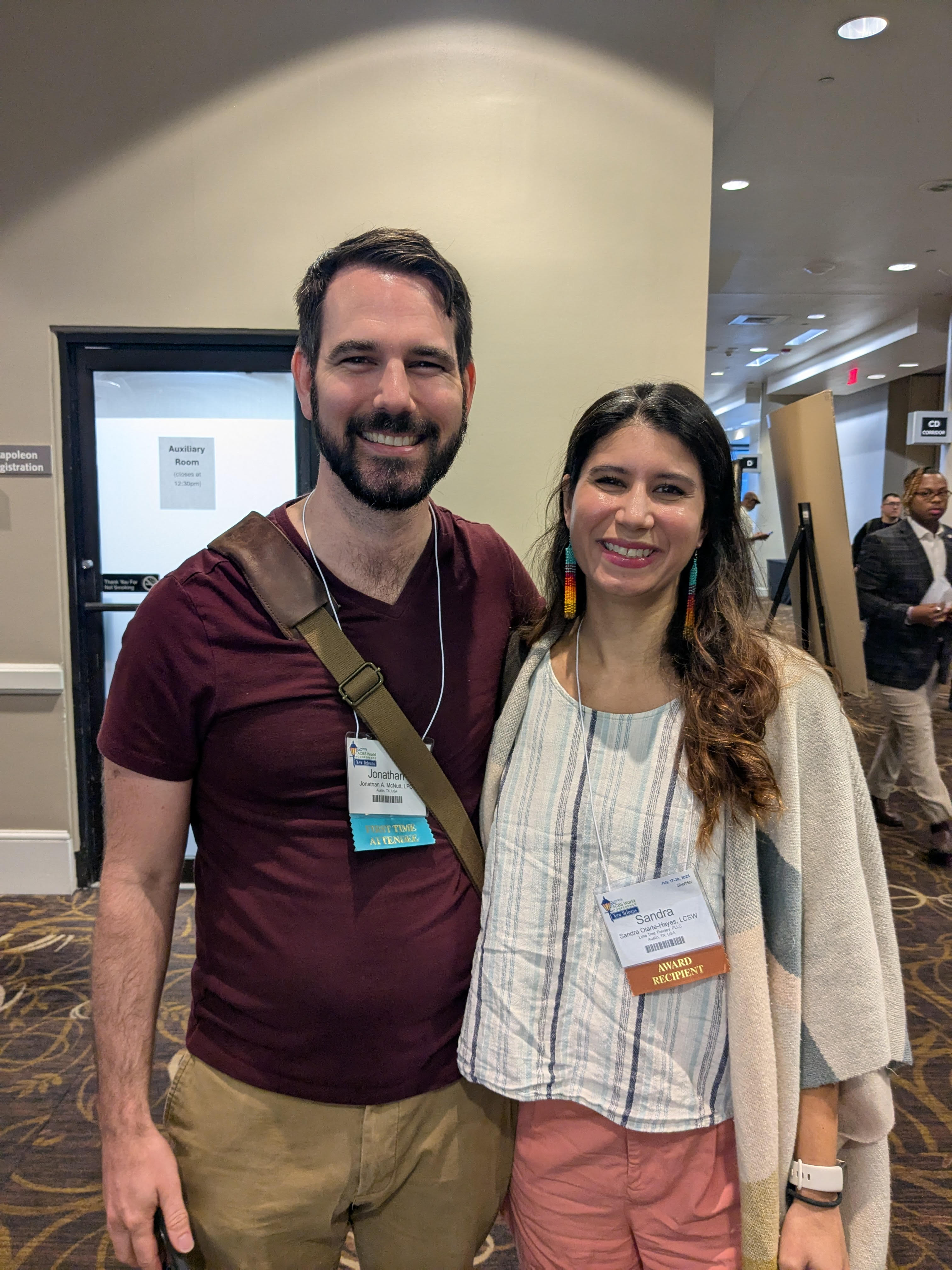
It was a wonderful experience! This was my first World Conference and it was energizing to meet people in-person who I had been engaging and collaborating with online for years. I left with a deeper sense of connection to the CBS community.
I also appreciated the breadth of topics represented in the program which ranged from research dissemination to experiential workshops. I was particularly impressed by the number of presentations focusing on DEI issues, particularly using contextual behavioral science to meet the needs of marginalized communities with different cultural contexts. Jennifer Shepard Payne’s workshop gave me lots of ideas to use with the communities I work with! I also particularly enjoyed Mavis Tsai’s workshop on Functional Analytic Psychotherapy.
Was there anything that stood out to you about the CBS community?
I find that big annual conferences can oftentimes feel stuffy, competitive, and isolating. I had the opposite experience at the World Conference where everyone I met was refreshingly warm, curious, and generous. There was a genuine openness to connection and people were willing to share what they were working on, what they were still figuring out, and where they felt uncertain. No one seemed to take themselves too seriously (even leaders in the field) and I was surprised by the playfulness of watching our community poke fun at themselves, one another, and CBS at the Follies Night. I was also pleasantly surprised by the diversity of languages I heard and countries represented.
What did you take back from your experience that has been helpful to you?
Clinically, I was really impacted by learning more about Functional Analytic Psychotherapy (FAP). FAP felt like a natural complement to ACT and expanded how I’m thinking about presence, vulnerability, and reinforcement in the therapy room. I had been considering launching a long-term interpersonal process group for some time and the workshop gave me the push to finally do so. I’ve now launched that weekly group and am applying FAP principles within it.
I was also energized by the conversations around cultural adaptations of ACT and its application across different communities and settings. Seeing how practitioners are thoughtfully modifying language, metaphors, and processes to better fit cultural contexts reinforced my commitment to making ACT responsive and relevant to the people I serve. I left with concrete ideas and a broader imagination about what’s possible.
On a relational level, I took back a stronger sense of belonging. I attended with members of my ACT peer consultation/skills practice group, and sharing the experience deepened our relationships in profoundly meaningful ways. We learned side-by-side during the presentations, practiced skills during role plays with intention, and explored New Orleans together. Since returning, one colleague and I have been in conversation about creating a multi-session ACT training in our local community that blends didactic learning with experiential skills practice. It feels like a direct extension of the energy we felt at the Conference.
Do you have anything else that you would like to share with the community?
More than anything, I’d like to express my most sincere gratitude to the ACBS DEI Committee for the opportunity to attend my first World Conference. I truly received something that I needed at the Conference during difficult times. I’m very grateful!